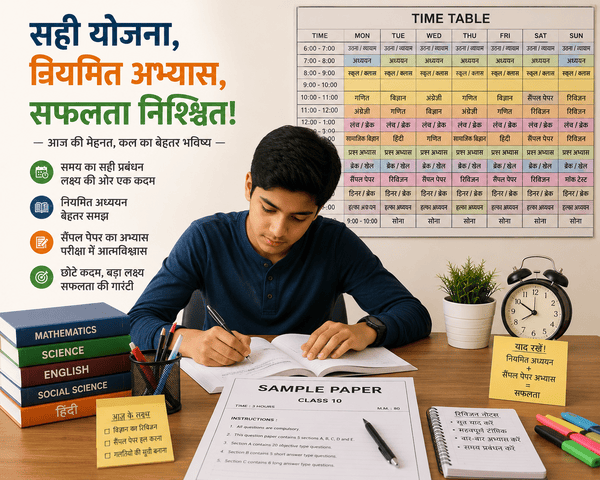
Almost every Class 10 student says they want 90%. Very few can tell you what they are supposed to have finished by the end of August. That gap — between the goal and the calendar — is the real reason scores stall, and it is the easiest thing in the world to fix.
What follows is the plan we walk our own students through. It assumes an ordinary student with an ordinary school timetable, not a topper with eight hours a day.
April to June: finish the first pass, slowly
The first three months are not for revision. They are for making sure nothing in the syllabus is completely unfamiliar. A student who has seen every chapter once, even shallowly, revises four times faster later in the year.
- Aim to be roughly 40% through each subject by the end of June.
- Keep Maths and Science slightly ahead of the others — they need the most revision time in January.
- Do not buy sample papers yet. They are useless before the syllabus is covered.
July to September: the marks are made here
This is the stretch that separates a 78% from a 92%, and it is also the stretch almost everyone wastes. School has settled into routine, the boards feel far away, and daily study quietly drops to twenty minutes.
Three things matter in this window:
- Daily targets, written down. Not "study Science" — "finish Chapter 6 numericals, questions 1 to 15".
- One weekly test, self-marked, on whatever was covered that week.
- A running error notebook. Every mistake, one line, with the correction next to it. By January this notebook is worth more than any guide book.
October to November: first full revision
By the end of October the syllabus should be complete. November is the first full revision pass — every chapter, quickly, with the error notebook open beside it. Most students discover here that they have forgotten a third of what they learned in May. That is normal, and finding out in November rather than February is the entire point.
December: sample papers begin
One full paper a week, timed, sitting at a table, no phone in the room. Then two hours marking it honestly. A paper that is written but not marked teaches nothing at all.
January: the second revision, and speed
January is about writing faster and presenting better. Students lose real marks here for reasons that have nothing to do with knowledge — unlabelled diagrams, skipped steps, answers that run past the word limit, questions left blank because time ran out.
February: keep it light, keep it steady
No new topics. No new reference books. Short revision sessions, the error notebook, past papers, and a proper night's sleep. A student who peaks in early February and burns out is a story we see every single year.
Where 90% is usually lost
Not in the difficult chapters. It is lost in the ordinary weeks of July and August, where nothing feels urgent and nobody is watching. That is precisely the problem a mentor solves — not by teaching, but by making sure the plan on paper is the plan actually being followed.